Open transactions are bad

Two identical queries have somewhat different execution times, though data layout, table format, everything… is quite same:

mysql> select count(*) from transtest;
+----------+
| count(*) |
+----------+
|    10000 |
+----------+
1 row in set (0.00 sec)

mysql> select count(*) from transtest;
+----------+
| count(*) |
+----------+
|    10000 |
+----------+
1 row in set (2.88 sec) < ---- oh noes!!!

The difference is very simple, though often forgotten. Multiversioned (MVCC) tables may have multiple versions (hence the name) of rows.
Even more, the engine will keep all versions of rows, that would be needed for oldest active transaction, just in case it requests some snapshot from the past.
Think of it as of some sort of time machine, just somewhat less efficient :)

If some old transaction is running, heavily edited tables will have more stored row versions.
In above case, second query had to read a million of rows to produce a count, when first one was working on clean environment.
Once the transaction holding old versions was rolled back, the query took 0.00sec again.

Databases (or DataACIDs) will take additional measures, often unexposed, to provide consistent data, so we may treat this as a feature, not a bug.

Conclusion: avoid long running transactions, especially if doing nothing. Oh well, avoid long running transactions with locks too, but that is already different question. If you spot anything sleeping – kill the slacker. At application level. :-)

Wikimaniaaaaa!!!

It is somewhat too late to post about Wikimania, so I won’t keep it long. Finally my lightning talk bits are on internet. Please note, that the idea of presentation came just few minutes before giving it. Pity there’s no video recording.

Anyway, the trip was pretty cool. Besides meeting all usual suspects at Wikimania, the whole world of amazing academia (this time, in a good sense) was revealed by my hosts. MIT rocks (especially my place of stay, TEP). Boston was pretty nice too – I quite enjoyed long walks there.

The conference itself had technical stuff extracted into ‘Hacking days’, so I ended up at quite tense technical track rather than hacking sessions. It wasn’t that bad, so I could create ‘socializing track’ at the main conference, and just hang around without any real agenda.

We had there quite less of startup spirit, that was so vivid last year. The current theme is “What we’re doing ” instead of “What we’re going to do”. For some it is maturity, for me it is boring :) I hope that was wrong impression.

I’ll sure try going there next year too. Just to see the usual suspects.

P.S. Wikipedia tremendous growth is back again.

I knew it – Metaverse runs on MySQL!

I was enjoying a fabulous read, Neal Stephenson’s novel Snow Crash. The book was written back in 1992, but it emphasized virtual reality and collaboration in a way that sounds modern still now.

What was fun (and made me write this spoiling post), is that it is easy to spot MySQL usage patterns in science fiction:

  • Metaverse – the virtual reality internet, has its counterparts already in our current non-fictional world. “Second Life” is a nice [MySQL powered] platform for virtual life and creativity, and it is now in state of early Metaverse evolution.
  • Central Intelligence Corporation (created after the merger of Library of Congress and CIA, as they were duplicating each other anyway) operates huge resources of user-provided content, like Flickr, YouTube or Wikipedia [MySQL powered again]. Though it had somewhat better interfaces and APIs, I guess that is what Web 5.0 is about ;-)

I really liked the idea how asynchronous replication and lack of locking effects virtual reality worlds – even these effects were taken into account by the author. Add neurolinguistics, civilization history, brilliant satire, and you really get the best geek fiction. Thumbs up for the book. The Diamond Age seems to be the next read.

On books, examples and wizards

I really like Flickr. I believe it is one of greatest services of the Web (my album is there :), and it runs MySQL. But I don’t understand why their database folks think nobody else knows how to build stuff. I have seen nice books and presentations from Yahoo! (oh wait!) and other guys, who have been building big systems and engineered their solutions properly, so they survived.

Technical literature was noticed:

Then there are whole books on the subject of capacity and scalability for the database layer.

Yes, they are good reads.

Or…

Then there are novels from developers that in many cases really don’t know the tricks of the DBMS they are working with, and create elaborate abstraction layers that automatically generate SQL for the DB in question from objects and such.

Some of these layers are made with efficient SQL in mind, or always allow to override their functionality with efficient SQL.

So, it is easy to answer this question:

But, with all these people who tell you how to do it, actually can they prove that it works under a constant high workload for many people all at the same time.

I believe these people can.

Now there’re parts of Flickr operation described:

You may be thinking to yourself yea right say you can do 20K + transactions per seconds that must be a crap load of expensive hardware all running, where all the data is served out of memory.

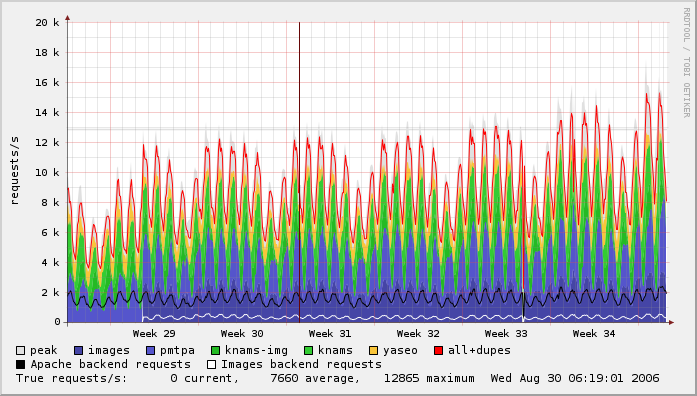
With proper data layout single 10000$ system may handle 10000 queries per second. Of course, hitting disk may decrease efficiency, so one may end up with 2-5$/query. I’m not sure Flickr would consider 100k$ database setup as expensive hardware. Here again, “all data served from memory” may sound expensive, but mostly systems serve just “most data from memory”. Like ours, which is running on those 10k$-class (disclosure: ~10 of them) machines and serving >30000 queries per second at the moment. And that is efficient.

This is blowing away minds and wiping stuff we know away:

All of our database connections are real time. Our load balancer for the database is written in 13 lines of PHP code.

There are lots of posts detailing how fast MySQL connections are and how database pooling isn’t necessary anymore. Our load balancer is actually 651 lines of PHP code, but it still connects to database at each request. And it takes less than millisecond to connect – quite affordable cost.

I am sure interested in all Flickr design specifics – it is nice application, perfect example and it seems to work. Though I don’t believe that we should deny any other knowledge, or we should be blindly following wizards and their examples. Every application differs, every community has different patterns and wishes, so we should rather follow what people need, and create good products for them, like Flickr. Sometimes even one-man (or all-volunteer) engineering team may do miracles, especially when there’re open platforms to build on.

It is hard to swallow the endless possibilities, that are provided by new type of services. I’m not sure wizardry these times is that difficult to swallow. In modern software world there’re no orthodox or unorthodox designs. There’re just ones which work and which don’t.